Chief Wahoo Demands Recognition, Insists He Is 'Basically the Me Too Movement, But for Logos'
On Opening Day of the franchise's first season as the Cleveland Guardians, the retired caricature staged a one-logo protest outside Progressive Field and accused Slider of 'mascot privilege.' Slider had no comment. Slider was inside, doing his job.
CLEVELAND, OH — Chief Wahoo arrived at Progressive Field at 9:15 a.m. on Opening Day carrying a poster board sign, a thermos of coffee, and what he described as “three years of unprocessed institutional grief.”
The sign read: I WAS NEVER EVEN ASKED.
He had underlined “asked” three times. He had also drawn a small arrow pointing to himself, which was unnecessary given that he was the only one there.
“I’m not angry,” he said, to this reporter and to a parking attendant named Dale who had not inquired. “I’m just saying that when you spend sixty-nine years as the face of a franchise and then one day the commissioner’s office sends a letter and you’re just — gone — without so much as a press conference, a transition period, a conversation —”
He paused.
“That’s not retirement. That’s erasure.”
Dale took his parking fee and waved through a minivan.
Some Background
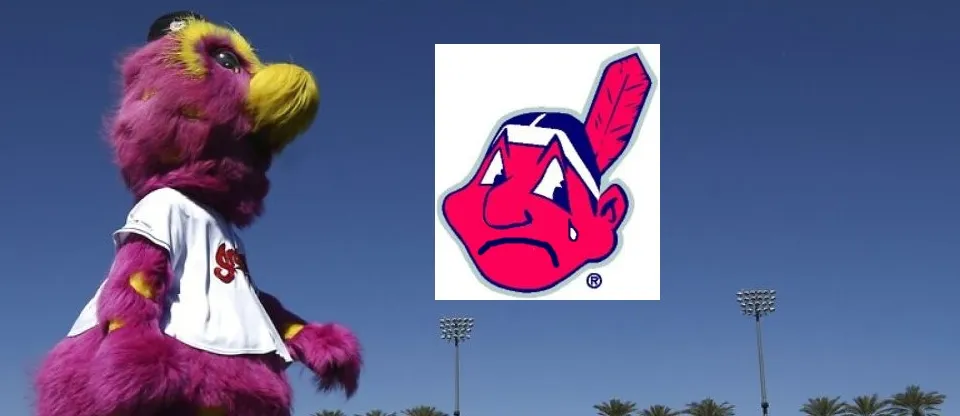
Chief Wahoo served as the Cleveland Indians’ primary logo from 1948 until his removal from uniforms in 2019, following years of protests by Native American advocacy groups who described him, consistently and correctly, as a harmful racial caricature. He was never, in any formal sense, a mascot. He was a logo. A graphic. A thing that appeared on hats and jerseys and stadium signage and bobbleheads and, for one inexplicable stretch in the 1970s, a line of children’s pajamas.
Slider — a large, furry, pink-and-red creature of ambiguous species who arrived in 1990 and immediately became beloved — was always the mascot. He had the job. He ran the bases. He got the hugs. He survived the rebrand without incident because he was never the problem.
Wahoo, who was very much the problem, has a complicated relationship with this fact.
“Slider,” Wahoo said, setting down his thermos, “has never spent a single day outside this ballpark wondering what he did wrong.”
This is technically true. Slider was inside the ballpark at that moment, taking photos with children.
The Me Too Comparison
At approximately 10:40 a.m., Wahoo made the comparison that would define the rest of the day.
“What I’m going through,” he said, carefully, “is not unlike what the Me Too movement was for women. Voices that were never heard. Identities that were never centered. Stories that were told about them but never with them.”
He let that sit.
“I was on a hat for seventy years and no one once asked me how I felt about it.”
There was a long silence. A seagull landed on a nearby trash can. The seagull left.
This reporter gently noted that the Me Too movement was about survivors of abuse demanding accountability from those in power, and that Chief Wahoo was, by contrast, a logo that had itself been the subject of decades of harm complaints.
Wahoo considered this.
“Right,” he said. “But I’m also going through something.”
The Slider Situation
Sources familiar with the relationship between Wahoo and Slider describe it as “nonexistent by mutual agreement” and “something neither of them wants to talk about.”
When asked, Slider — reached through a team spokesperson — declined to comment. The spokesperson noted only that Slider “wishes everyone well” and “is very focused on the 2022 season.”
Wahoo interpreted this as shade.
“Of course he has no comment,” Wahoo said. “He’s inside. He gets to just be inside. He never had to stand in a parking lot. He never had to have a conversation with a seagull.”
(There had been no conversation with the seagull. The seagull had simply been there briefly and then left.)
“Slider has mascot privilege,” Wahoo added. “I said what I said.”
What He Wanted
When pressed on what, specifically, he was asking for, Wahoo’s answer evolved several times over the course of the morning.
Initially: a formal apology from Major League Baseball.
Later: a plaque. “Somewhere tasteful.”
By noon: acknowledgment. Just acknowledgment. That he existed. That it was complicated. That the story was longer than a logo retirement memo.
“I’m not asking to come back,” he said, and for the first time something in his voice shifted into something that wasn’t grievance. “I know I can’t come back. I understand why. I’m not — I know what I was.”
He looked at the sign he’d made. He’d been holding it for three hours.
“I just never got to say anything about it. That’s all.”
He folded the sign under his arm, picked up his thermos, and left before first pitch.
He did not leave a forwarding address. He did not check the box score.
The Guardians won, 4-1.
Slider caught a t-shirt cannon misfire directly in the face in the seventh inning and the crowd loved it.
Chief Wahoo was asked, as he left, if there was anything he wanted fans to know.
He thought about it for a while.
“I think the pajamas were actually pretty good,” he said. “The 1970s ones. I don’t know if anyone remembers those. I thought they were nice.”
He walked to his car.
It had a parking ticket on it.